

MileValue is part of an affiliate sales network and receives compensation for sending traffic to partner sites, such as CreditCards.com. This site may earn compensation when a customer clicks on a link, when an application is approved, or when an account is opened. This compensation may impact how and where links appear on this site. This site does not include all financial companies or all available financial offers. Terms apply to American Express benefits and offers. Enrollment may be required for select American Express benefits and offers. Visit americanexpress.com to learn more. All values of Membership Rewards are assigned based on the assumption, experience and opinions of the 10xTravel team and represent an estimate and not an actual value of points. Estimated value is not a fixed value and may not be the typical value enjoyed by card members.
There are five cardinal rules of American Airlines award tickets that I wanted to put together in one place for reference. All AA awards must comply with these rules and several other minor ones.
You should consult this post when planning an AA award, especially if you are trying to add a stopover or free oneway.
1. Stopovers are not allowed on American Airlines awards.
All connections on purely domestic itineraries must be less than four hours. All connections on international awards must be less than 24 hours.
2. Each of the two directions-outbound and return–must not exceed AA’s Maximum Permitted Mileage for your origin and destination by more than 25% as flown.
This is not as complicated as that sentence makes it seem. Maximum Permitted Mileage (MPM) is a term of art. It is a number of miles that the airline puts on all city pairs for which it publishes a fare. MPM is not the direct distance between two cities; it is usually a larger number.
You can find the MPM for a city pair on Expert Flyer, the KVS tool, or by asking an AA agent. Here’s how to do it on Expert Flyer.
Example: Say you want to try this routing, LAX-BOS-NRT-TPE, from Los Angeles to Taipei.
First I would head to Expert Flyer, and I would look up the MPM for LAX to TPE since that is the origin and destination.
LAX-TPE has an MPM of 8,137 miles. (Note that this is much farther than the direct distance between the two, which Great Circle Mapper lists as 6,799 miles.)
Next I would multiply the MPM by 1.25, since we can exceed the MPM by 25% on awards. 10,171 miles is 25% greater than the MPM of LAX-TPE. Now, I can go to gcmap.com and check the distance of our putative routing. LAX-BOS-NRT-TPE is 10,669, which exceeds the allowable 10,171, so this is not a valid routing.
That means that AA would break this into two awards–LAX-BOS and BOS-TPE–and you’d have to pay more.
3. The airline that operates the flight that connects the two regions must have a published fare for your origin and destination city pair.
This is a rule that trips up a lot of otherwise awesome awards. It’s frustrating, and it’s not clear why the rule exists, but you have to know it.
Example: You want to fly MEL-LAX-JFK-BWI and will fly on Qantas from MEL-LAX. That means Qantas–the region connecting carrier–has to have a published fare from MEL-BWI for the routing to be valid.
How do you figure out if there is a published fare between a city pair? I check on Expert Flyer. Here’s how. Another free, roughly accurate, way is to see if you can book a ticket between the city pair on the operating airline’s website or kayak.
Or you can just see if you can have it price as one award over the phone. If you can, you have a legal routing and stopover.
4. All award travel must be completed within one year of its booking.
You can change your award to a later flight as many times as you want, subject to the fact that all travel must be completed within one year of the ticket’s issue.
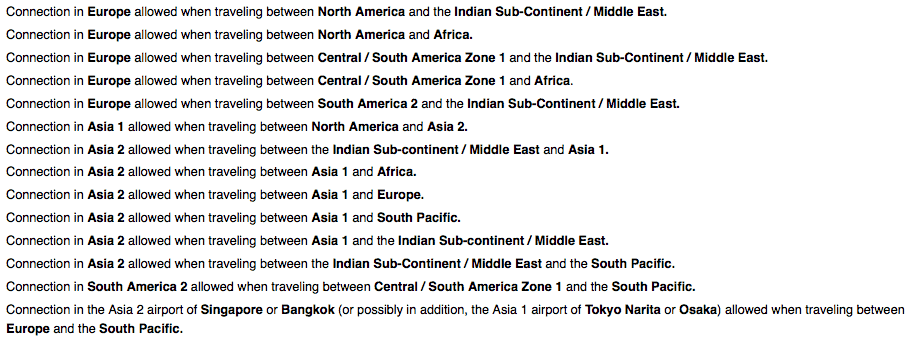
5. Awards between Region A and Region B cannot transit Region C unless specifically allowed.
Most airlines let you route however you’d like as long as you don’t exceed MPM. But not American Airlines. If you want to go from the USA to Australia, you can’t transit another region, say Asia, no matter what.
Another annoying one is not being able to transit the Middle East en route from USA to Africa. That makes it impossible to use Etihad.
Here is a list of regions you can transit from flyerguide.com, which I believe is complete and accurate.
[…] has a post today talking about the rules one has to obey when booking AA awards. AA has a great program, but […]
[…] airport from which you leave North America or the first at which you arrive in North America. See The Five Cardinal Rules of American Airlines Awards for more […]
[…] awards using AA miles must comply with the Five Cardinal Rules of American Airlines Awards. If you live at one of the cities served by one of these flights, you are looking at the […]
[…] started by learning about The Five Cardinal Rules of American Airlines Awards. While most of the rules were fairly easy to follow, the fifth rule–unique to American […]
[…] One way to get to Tahiti with American miles is on non-oneworld partner Air Tahiti Nui, French Polynesia’s international carrier. For getting to French Polynesia, Air Tahiti Nui’s only route of interest to us is Los Angeles to Tahiti. Air Tahiti Nui also flies to/from Tokyo, but you can’t route to the South Pacific via Asia on one AA award. See The Five Cardinal Rules of American Airlines Awards. […]
[…] it satisfies various award routing requirements, etc. I just found this post on Mile Value: https://milevalu.wpengine.com/the-five-cardin…rlines-awards/ It says that the "gateway city" at which you take a stopover has to be the actual one […]
[…] Other problems include an unavoidable $25 fee per ticket for awards booked by phone even though the majority of partners can only be booked by phone. (AA.com is adding partners at a nice clip including Finnair, airberlin, Qantas, and Hawaiian recently.) AA also has several routing rules whose only purpose seems to be to frustrate me. (See rules 3 and 5 in Five Cardinal Rules of American Airlines Awards.) […]
[…] 12,500 one way for off-peak domestic travel, to 20,000 one way to Europe. If I take advantage of the trick to get a free one way to Hawaii, I could easily get a trip to Hawaii and to Central America out of […]
[…] Honolulu is a valid stopover on a 50,000 mile award from New York to Japan with American Airlines miles. See Five Cardinal Rules of American Airlines Awards. […]
I am trying to figure out a trip to Hong Kong or Beijing form DFW with a possible stopover in Honolulu preferable coming home for some R&R. Does the published fare have to be a direct flight? For example there is a published fare from DFW to Beijing but it goes through Chicago. I do not get the stopover without adding miles like I do when I experimented with Tokyo for which there is a direct flight from DFW. I will be using AA/Oneworld award miles.
Thank You.
All that matters is that the overwater carrier has a published fare. You don’t have to route in the manner that the published fare does.
[…] This post presents the basics of using aa.com for award bookings. It is not a comprehensive guide to booking American Airlines awards. For that, start at the Five Cardinal Rules of American Airlines Awards. […]
Hi, I live in LA and was hoping to do a trip to both Hawaii and Europe next year, although as separate trips, while taking advantage of a “stopover”. I’ve managed to find availability on HNL-LAX-BCN-LAX-HNL on AA in coach for only 40k miles, but was wondering if I can now change the dates of the first and last legs so that I end up with a LAX-BCN-LAX flight and then a LAX-HNL-LAX. Will AA let me change the dates and the orders of the flight after booking them? Thanks for the help!
Will AA allow switch an Etihad itin. ORD–>AUH–>BOM to a Royal Jordanian one, ORD–>AMM–>BOM?
The origin / destination remain the same…but it’s an airline change…
thanks!
should be a free change –> http://www.aa.com/i18n/AAdvantage/redeemMiles/makingAwardReservations.jsp
[…] Airlines now releasing two saver suite awards -A side by side comparison of Airline Elite Status -The five Cardinal rules of American Airlines awards This is just an eclectic list of things from random blogs. If a newbie asks for "Could […]
Hello, thank you for your valuable post. I have one question: I’m traveling oneway award from South pacific to Europe and wanted have connections in Asia1 and Asia2. Do you think this itinerary is valid? PPT-NRT-SIN-KUL-HKG-LHR.
[…] Two months ago, thexfactor emailed me to tell me that he’d booked something online at aa.com that was against one of the rules I laid out in The Five Cardinal Rules of American Airlines Awards. […]
[…] Two months ago, thexfactor emailed me to tell me that he’d booked something online at aa.com that was against one of the rules I laid out in The Five Cardinal Rules of American Airlines Awards. […]
Hello, thank you for your valuable post. I have one question: I’m traveling oneway award from South pacific to Europe and wanted have connections in Asia1 and Asia2. Do you think this itinerary is valid? PPT-NRT-SIN-KUL-HKG-LHR.
I had an advantage award on hold (SFO-ORD // ORD -HKG -KUL -DPS) on AA/CX/MH/MH. After some painful argument with the agent, they were finally able to verify through tariff that the routing is still within 1.25 of MPM. They then priced it as one award. I put a hold on the ticket and received a voicemail three days later. They informed me that the ticket got “kicked back” to two awards. I called this morning and asked what’s going on. Apparently, someone from the AAdvantage Liaison department is claiming it wasn’t a valid award pricing. There seems to be a publish through fare fro SFO to DPS on CX so I don’t really know what’s going on. I’m supposed to call back with an answer from the Liason department (the person in that department is currently out of the office).
The agent called back and said she would go ahead and ticket the award. She took my info and assured me that the award would be ticketed. A few hours later I received a call from the “training desk”, telling me my award was invalid. I asked her why, and she mentioned that I am backtracking and this is not a valid routing. I then ask her when in the AAdvantage T&C restricts these sort of routing. She couldn’t find it but assured me that this is a rule. The fact that it is not in the T&C is irrelevant. This sounds fishy to me, and I’ll be asking for some legal advice regarding this but thought I’d ask you guys first. I’m inclined to skip the SFO routing and file SCC.
What do you think? Am I in the wrong here? Thanks
I don’t know what an SCC is. I’ve fought hard through talking to get an award booked. I’ve never made it anything besides something between me and the airline though. They hold all the cards.
[…] has its own rules. United’s doesn’t worry about MPM for awards, and it has no crazy published-fare-from-overwater-carrier rule like American […]
[…] booking award flights was first shown to me by my friend Andrew and was probably first pioneered by Scott at Mile Value. Here’s how to get a free one-way to Hawaii added to our […]
Is this AA one way award for 35K miles allowed : ORD to Maui, stopover for 10 days, then HNL to Manila using JAL? If not, will this work: ORD to HNL ( purchase HNL to OGG roundtrip ) then HNL to Manila? How good or bad is the availability for this itinerary
[…] Five Cardinal Rules of AA Awards […]
Hi Scott,
I recently booked a trip with ITIN as follows:
CX888 YVR to JFK on 8/26
JL5 JFK to NRT on 8/27
JL735 NRT to HKG on 8/28
first leg from YVR to JRK is overnight….with the JFK – NRT flight leaving around 1pm…
I was told it has be be priced at two awards with the YVR to JFK being a separate one way award because I am going to wrong direction, even tho the gateway city is New York. Is this right?
“Going the wrong direction” is not a rule that I know. Are you sure you are following the other rules, though?
I’ll be booking an award ticket from SYD-DFW and would like to use the free one-way from DFW-ANC.
I’ll be booking the SYD-DFW ~330 days out and won’t be using the one way until 6 months after the SYD-DFW flight.
Have you had any experiences with the AA agents allowing the one-way to be added 6 months after booking the original award?
Thanks!
You can’t do that. All travel must be completed within one year of booking the award. Your free oneway would be 17 months after booking the award.
[…] city you want. This isn’t an American Airlines award where the rules punish people who like to fly to small […]
[…] has quite a few frustrating award routing rules (you can read them in Scott’s post The Five Cardinal Rules of American Airlines Awards). American annoyingly only allows routing through Europe or the Middle East when going from North […]
I travel a lot between OGG and TUL. I recently found a 37.5K award for OGG – DFW- TUL in April but there was only one. I was hoping to get another for my spouse – to no avail. Called AA rez and asked for them to send off a request for addl allotment and it came back none avail. and so did the appeal.
Not sure if I should book the one and hope for another later or not. Any advise? The non stops btwn OGG and DFW are getting really hard to come by lately. (usually they throw in the LAX connection and the 1st cl seats are not much better than coach)
I can’t predict whether a second one will open. Sorry. Try this: https://milevalu.wpengine.com/will-you-find-last-minute-award-space-heres-how-to-estimate-your-chances/
[…] For more details, see #3 in this post by MileValue. […]
[…] that she could have stopped over in Europe in either or both directions for no extra cost. Normally AA awards cannot have stopovers outside of North America, so stopovers in Europe are a huge […]
Question: Is this a valid itinerary on an AA award. Cathay Pacific roundtrip ORD to MNL then a free one way ORD to OGG 2 months later or ORD to OAK. Thank you.
I am confused. I booked a 62,500 first class award ticket on AA from Miami to Washington Dulles , layover is 7 hours, then Dulles to London (LHR) in March 2014. Is there a way I can change the route to go to Hawaii in July 2014 using free one way stopover?
Thanks,
Is MEX-YYZ//YYZ-ICN-PVG legal? or MEX-YYZ//YYZ-ICN legal?
Who flies YYZ-ICN in oneworld?
Pardon my ignorance. Are you suggesting that I should use star alliance? and/or ? I thought AA allows stop-over on one way award.
It does, but as this article says, the stopover can only be at the North American International Gateway city. For YYZ to be that, there would need to be a direct flight from YYZ to Asia on oneworld.
Got it. MEX-JFK//JFK-ICN should work, then?
There is no JFK-ICN direct on oneworld.
Thank you for your post. I am wondering if MEX-YYZ//YYZ-ICN is legal.
[…] published the succinct Five Cardinal Rules of American Airlines Awards which is a must read for any award booker. Some of the most frustrating are the strict regional […]
[…] American Airlines allows a stopover on each one way award at the International Gateway City, which is the last North American city you fly out of on your way to Australia and the first one where you land on the way home. For more info an examples, see The Five Cardinal Rules of American Airlines Awards. […]
[…] From the Five Cardinal Rules of American Airlines Awards: […]
[…] MileValue has a more detailed explanation of the rules with examples. […]
Have you had success in delaying the free oneway with Delta, as you describe here? I’m looking to book a trip to Costa Rica with a Delta Award ticket, and would like to use the free oneway but it would need to be farther out than the 330 days. Basically, I’d like to do Costa Rica in Feb ’15, and then go to Denver on a free oneway later in say October ’15.
[…] in all cases, as explained here. My guess is there was a restriction on a particular routing you wanted to do. Again, […]
[…] The full exception list can be found here. […]
[…] Though this is an extremely basic itinerary, there are several things everyone should be mindful of before tackling an Etihad award including how to search for Etihad award space and mastering the Five Cardinal Rules of American Airlines Awards. […]
[…] priced/offered on websites like expedia, etc) The Five Cardinal Rules of American Airlines Awards: https://milevalu.wpengine.com/the-five-cardin…rlines-awards/ Doradee: Wanted to let you know that usually the FT forum is more helpful than a five word empty […]
[…] the Maldives, or Australia in Cathay Pacific Business Class with American Airlines miles would require two awards per direction because American has strict routing rules. Consider using US Airways miles to these […]
[…] a fare from your starting city to your final destination. That’s a big “if.” (See Five Cardinal Rules of American Airlines Awards for more info on this rule and how to figure out if you […]
[…] the rules–The Five Cardinal Rules of American Airlines Awards–are the same either way you think about your trip. If the reader adds an international flight […]
[…] published the succinct Five Cardinal Rules of American Airlines Awards which is a must read for any award booker. Some of the most frustrating are the strict regional […]
[…] more reading make sure to check out The Five Cardinal Rules of American Airlines Awards as well as What Would the Perfect Marriage of the American Airlines & US Airways Frequent Flyer […]
[…] The full exception list can be found here. […]